
What Is Conflict Theory? Conflict refers to a dispute or struggle regarding anything. Conflict theory, rooted in sociology, was first presented by Karl Marx. Keeping politics in mind, Marx studied resources at the political level—specifically the struggle over money and wealth. In the beginning, he talked about social relationships, nourishment, and related matters. The term …
Conflict Theory: Understanding Social Struggle, Inequality, and Power
What Is Conflict Theory?
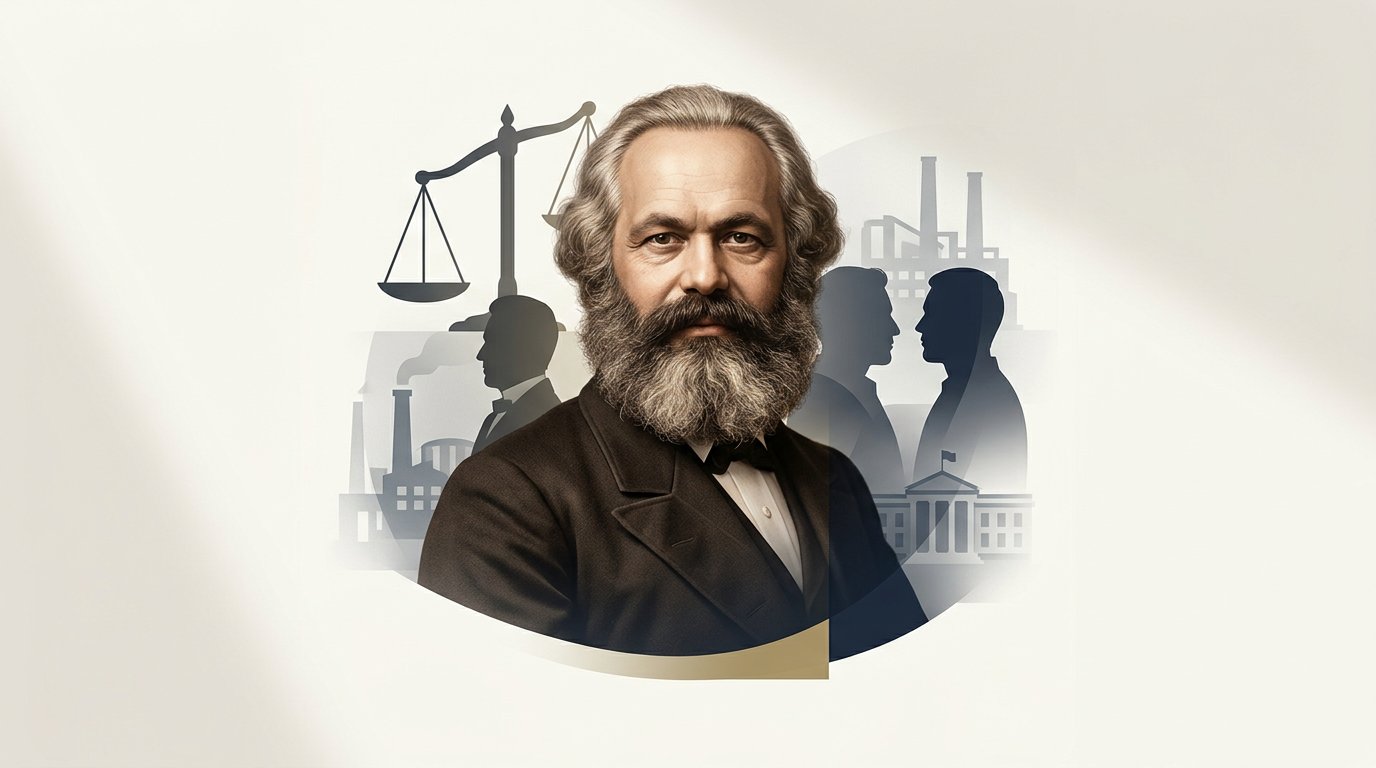
Conflict refers to a dispute or struggle regarding anything. Conflict theory, rooted in sociology, was first presented by Karl Marx. Keeping politics in mind, Marx studied resources at the political level—specifically the struggle over money and wealth. In the beginning, he talked about social relationships, nourishment, and related matters. The term “bourgeoisie” refers to a separate faction or class in society.
Bourgeoisie and Proletariat: The Two Classes
There are two primary classes:
- Owners of Capital (Bourgeoisie): Those who own the means of production. Capital refers to the money invested at the beginning to establish a business or factory.
- Working Class (Proletariat): Those who work inside the factory or business. The owners used to exploit and oppress the working class, and the relationship between the two was fundamentally tied to this dynamic.
Karl Marx and His Influence
Karl Marx was active on the political front of the nineteenth century. Although he passed away in 1883, his influence extended well into twentieth-century politics and economics.
His famous works include:
- The Communist Manifesto, published in 1848
- Das Kapital, published in 1867
These are very significant texts in the study of conflict theory.
Competition and Limited Resources
One of the central tensions in conflict theory relates to limited resources. Resources in any society are limited, so tension and competition will always remain. Conflict arises because of this competition over scarce resources.
Institutions and Inequality
This thought shows that inequality exists within institutions. Those who have more money or more power will try to maintain that power and money. Those who do not have it will try to gain it. Because of this, inequality becomes embedded within the system.
Marx drew this on the basis of class. That was the original conflict theory framework. Later, other scholars expanded the conflict theory to include all other dimensions—not only class.
Four Primary Assumptions of Current Conflict Theory
Current conflict theory identifies four primary assumptions:
- Competition
- Revolution
- Structural Inequality
- Power
Competition
Competition exists at every level—in school, in the workplace, in society. A person will always compete, and healthy competition helps. In a class, only one person can come first. There is a lack of resources, and competition determines how those resources—whether material or intangible—can be obtained.
Material resources include money, property, commodities, and objects.
Intangible resources include time, dominance, social status, and other non-physical assets.
Competition can exist over both types of resources.
Revolution
When competition turns into conflict, the struggle can take a revolutionary form. A movement against the government, for example, is a kind of struggle—you are not in agreement with the government, so you try to compete or resist. Whatever result comes out of that—whether changes happen or not—that is a revolutionary event.
In the context of society, when a larger external conflict arises—for example, if war breaks out between two countries—the society unifies as one. But when things are normal and there is no major external problem, smaller internal conflicts always remain.
Structural Inequality
Inequality can be experienced even at home. For example, you may feel that your parents love another sibling more than you. That is a form of structural inequality.
If someone has power or more money, they receive advantages in various areas. If someone in politics has a very good image, they can gain power. If the situation of tension increases slowly, it can take the form of war.
Power
Power dynamics operate on the basis of various factors including gender. Society is divided into two groups:
- Dominant Group: The main group that holds power.
- Subordinate Group: The group that operates under the dominant group.
In patriarchal society, men are considered the main group and women the subordinate group. Conflict occurs when men completely dominate. Domination is based on power, and specific power resources are mostly limited to men.
Gender Roles and Conflict Theory
If women become financially independent and start earning for the family, a democratic environment can come at home where both have a role in decision-making. But even then, domestic work pressure largely remains on women.
Even today, if someone in the household does a job, she will first complete her domestic work before going, or after coming from work, she will complete her house work. Some amount of work pressure has always remained on women. This is what the Marxist perspective says about gender roles.
Engels said that when we talk about gender roles, men represent the capitalist class and women become the proletariat.
Feminist Theory and Gender Inequality
Feminist theory is one type of conflict. The struggle exists for gender equality—the question of whether inequality should increase or not. Equality is always used as a goal, and both male and female voices improve when it is pursued.
Education and Conflict Theory
Conflict theorists believe that public schools do not reduce social inequality. Rather, conflict theorists believe that inequality increases because of education.
Many say that if a person is educated, their thinking will be at a higher level. But conflict theorists believe that the education system reinforces existing class differences, and those differences become stronger.
Sorting and Social Inequality
The practice of sorting—dividing students into classes, sections, and levels—is considered a form of inequality. For example, in school, when there are multiple sections (A, B, C, and so on), children whose parents have more power are placed in better sections, while others are sent elsewhere. Conflict theorists do not believe that education reduces inequality; rather, they argue it increases inequality.
Social Tracking
Conflict theorists also criticize the education system for promoting social tracking. Different sections and divisions reinforce inequality. The focus is often on job-oriented outcomes—just bringing marks—while moral values that should be taught are not given attention.
Curriculum as Social Control
Conflict theorists argue that whatever curriculum is taught, its selection is not accidental. The different things and different sections taught are deliberate, and they criticize this as a form of social control.

Aishwarya Bharti
Aishwarya Bharti is a passionate educator committed to inspiring minds and shaping futures through quality education. Dedicated to fostering curiosity, creativity, and lifelong learning, she believes in empowering students with knowledge, confidence, and the skills they need to succeed in an ever-changing world.
Subscribe to Our Newsletter
Keep in touch with our news & offers
Thank you for subscribing to the newsletter.
Oops. Something went wrong. Please try again later.