
If we talk about it in Hindi, we call it “pratikatmak antarkriya siddhant,” because what do we call symbol in Hindi? “Pratik,” and interaction we call “antarkriya.” So symbolic interaction becomes symbolic interaction. What Symbolic Interaction Theory Discusses It means what the board members/readers will be appointed for: that it will be related to symbols …
Symbolic Interactionism: Meaning, Core Principles, Gender Equality, and Education
If we talk about it in Hindi, we call it “pratikatmak antarkriya siddhant,” because what do we call symbol in Hindi? “Pratik,” and interaction we call “antarkriya.” So symbolic interaction becomes symbolic interaction.
What Symbolic Interaction Theory Discusses
It means what the board members/readers will be appointed for: that it will be related to symbols and symbolic interaction. The symbol interactions that we submit become symbols in society, and some meanings become attached to them.
Interaction can happen with oneself or with anyone. For example, if you are looking at this, it will be a question. If you are using a mobile phone, your interaction took place with the phone. Suppose a candidate interacted with an interviewer. Another can be an individual’s interaction with a scientist.
We will talk about these two kinds of interaction. It can be international, and it can be with social advancement.
Questions come from this in this way. Interaction focuses on micro-level relationships, in which an individual has a relationship with society. It focuses on that.
Smoking Among Teenagers
Another example is quitting smoking among teenagers. This is its basic example.
For example, smoking among teenagers—teenage people, children who are in school time—begins to be considered a matter of meeting or belonging, and under pressure, they also start smoking. After that, they become addicted.
Gradually, people who are around fifteen—what happened there? The symbolic meaning of smoking.
In a research study, it was found that they are fully aware that drinking and smoking can have dangerous effects and how dangerous they can be for your health. It is dangerous. But the symbolic meaning at some places overrides the actual fact; that is, the symbolic meaning becomes stronger than the actual fact.
Symbols, Meanings, and Society
These five things will be used again and again. First comes the typing of human society. We interact with each other, communicate, and then society is formed. In society, a particular thing has an established meaning, and we use symbols.
For example, if we talk about society—not only Indian society, but society as a whole—when we join both hands and stand like this with both hands together, it becomes a symbol. What is its established meaning? “Namaste,” or we can say that you are showing respect to someone. Its meaning has been established.
But in the world, individual views may exist among one another because individual differences exist. Every individual may have their own meaning, their own view, and their own interpretation.
Different individuals communicate again in society with others. What happens through communication for joint action? Through that, society is formed. It will remain in a particular way, but this society’s relation can change.
For example, Indian society, American society, British society—if you take society, then this is Indian society. What has happened here? Therefore, we communicate our views and comments in the form of symbols.
You may communicate with your friends. You become part of society through communication. But if, in place of Indian society, you take American society, as soon as society changes, the symbol will change because, if we talk about American society, this is considered something else there. This shows that it can always change with society.
Development of Symbolic Interactionism
When people started studying this, symbolic interaction developed. These thinkers expressed the idea that individual differences express their ideas. All these interactions are related to symbolic interaction. Since we are discussing things related to symbolic interaction, we are calling them interactions.
All these interactionists agree on one thing: Where do the data or information come from? They come from human interaction. Everyone agreed on this point.
George Herbert Mead and Herbert Blumer
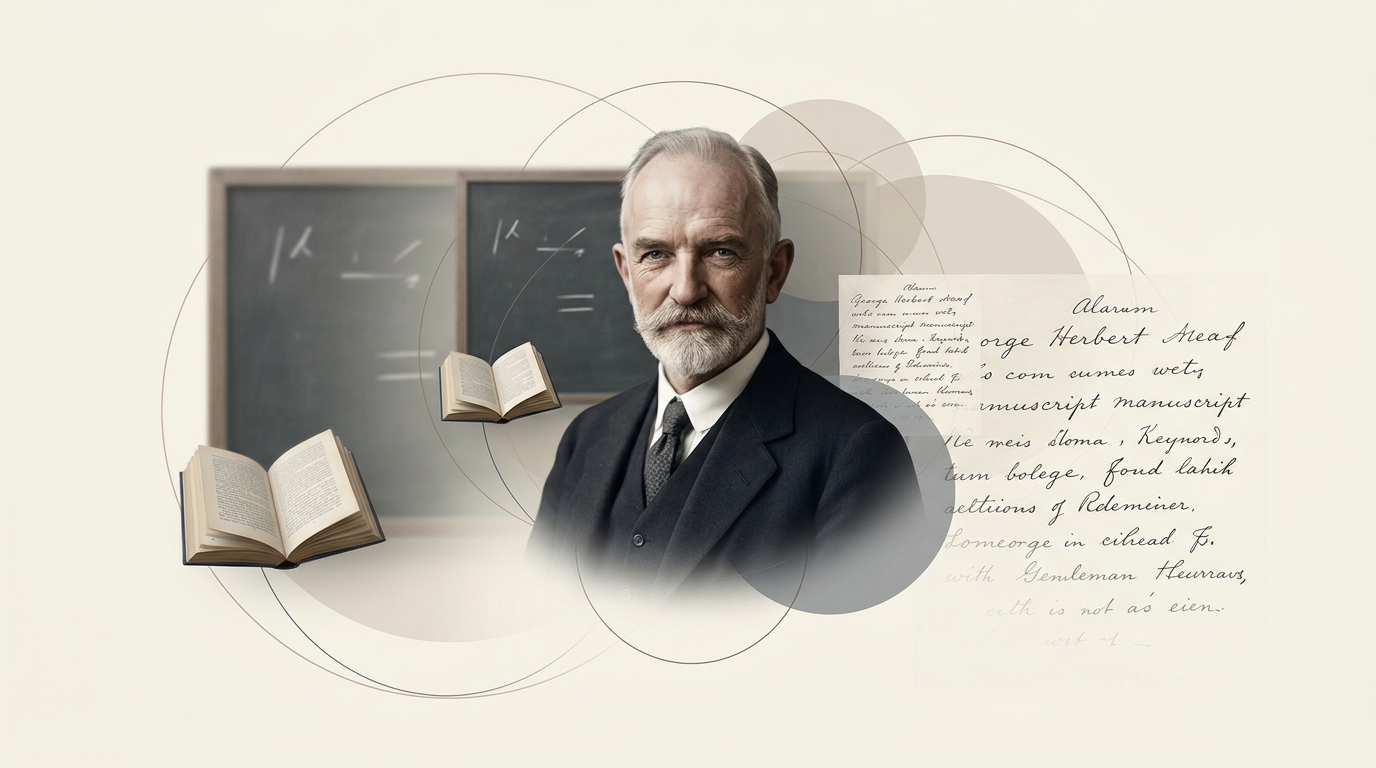
From here, they began to give their interpretations. George Herbert Mead is called the father of symbolic interactionism.
A student may be asked in an examination: Who gave the term “symbolic interaction”? Herbert Blumer gave it. That is, the term “symbolic interaction” was given by Herbert Blumer. But the father of symbolic interactionism is George Herbert Mead.
The term symbolic interactionism was given by Blumer, but Mead is considered the father of symbolic interactionism. He also gave the idea of socialization, “I,” and “Me,” and later, other thinkers discussed interaction-related ideas. Therefore, Mead is considered the father of symbolic interactionism.
Core Principles of Symbolic Interactionism
We will discuss three core principles. These are three basic propositions, three basic things, or premises. If we understand them, this theory discusses them.
As we repeatedly talk about symbols and meanings, it discusses how human beings derive the meaning of anything or how meaning becomes established. Symbolic interaction is the process through which interpretation takes place.
For example, suppose you are new to college. You are going to college for the first time, and a teacher is coming from the front. Every child will have a different imagination, a different judgment about that teacher.
Every child will be interpreting the teacher’s actions in their own way, looking at how they behave, what kind of person they may be, and what kind of teacher they may be. This is interpretation of actions, and each person’s visualization is different.
The principles that we will discuss are basic propositions about how humans make meanings. These were given by Blumer. The name symbolic interactionism was given by Blumer, while George Herbert Mead is considered the father of symbolic interactionism.
The initial point is that the three core principles, from the perspective of symbolic interactionism, will concern meaning because we are revolving around symbols and meanings. Therefore, the principle of meaning becomes important.
1. The Principle of Meaning
The first principle is that human beings act toward things according to the meanings those things have for them. Meaning determines behavior.
For example, suppose someone shows a thumbs-up sign. Its meaning may be good in your society, and the response depends on your action. But if you show the thumbs-up symbol to someone in American society, it may have a different symbolic meaning. As soon as the meaning changes, behavior also changes.
2. The Principle of Language
Human language—in the definition of language, it is said that language consists of speech sounds through which you express yourself.
What things can you express? You can express your emotions, express ideas, and express your thoughts. Therefore, language becomes very important.
The second principle is that language provides meaning to humans by means of symbols. That is, you express through symbols.
3. The Principle of Interpretation
The meaning of the third principle is that meaning changes through interpretation. As we discussed with the example of the professor in college, every child has a completely different interpretation.
One child may form an opinion of that teacher by seeing their actions. Thus, this principle says that meanings can change through interpretation.
The Three Basic Propositions of Symbolic Interactionism
The three basic propositions of symbolic interactionism are the basis of this theory.
- Humans act toward all things according to the meanings those things have for them.
- The meaning of things arises in the process of social interaction.
- Meanings can change through an interpretive process when individuals interpret them.
The first means that all these propositions concern meaning.
As we discussed earlier, meaning, language, and thought are related. When we communicate, meaning is created.
How are these meanings created? They are created through interaction with other people. These meanings can also change through an interpretive process when individuals interpret them.
These are the three propositions. We discussed that meaning is the basis of human action. Human beings attach meanings to things. There can be two forms of this.
Meaning Attributed to Objects
The first is that meaning is attributed to objects.
For example, when we hear the word Diwali, based on the interactions we have had with society until now, something may come to our mind. The meaning of an object may come from such things.
How We Deal With Objects
The second is how we deal with objects.
For example, suppose a teacher is showing an education-related video through a video player. The teacher uses that video player as a means of education. But for us, based on our physical attachment and user experience, the meaning may be different.
The view was that the meaning of a video player does not exist independently; you derive it on the basis of your own experience. What do human beings do? They derive the meaning of anything based on their experiences.
The Mind, the Self, and Society
In this regard, in interactionism, we should properly understand the relationship between symbols, meanings, and society.
The mind is an activity through which we use symbols. Through the ability of the mind, we can derive meanings from symbols.
For example, what does Diwali mean in our minds? It may mean that Lord Rama returned. It may mean the victory of truth over falsehood, the victory of good over evil. In a very simple way, the mind will provide this meaning.
The self is the ability through which a person reflects on oneself, but it is based on the practices of others. Society is a fabric of social relationships, and these social relationships are created by human beings.
Symbolic Interactionism and Gender Equality
If we look at gender and social interaction, we see that gender becomes stronger over time through interaction. Gender is socially constructed.
Through social interaction, things happen on the basis of gender. For example, if I am a girl, I will do this work; if someone is a boy, he will do that work. This division is also made on the basis of gender.
The symbolic interactions based on gender—the symbols—often take the form of stereotypes. Such stereotypical thinking is reflected many times. Discrimination then begins on the basis of gender, which we call inequality.
Inequality is not necessarily happening only to girls. It can also happen to boys. If inequality is happening to a girl, it is gender bias; however, one should not always assume that gender bias happens only to girls. This gender bias then becomes inequality.
Thus, inequality becomes connected with symbolic interaction. From interaction comes gender, and from gender, inequality is formed.
The Role of Symbolic Interactionism in Education
It becomes clear that, at the school level, you will find children who are quick to grasp things sitting in the front rows.
You may have noticed in your school that those who want to sit in front, or those who have the desire to learn more, decide that they should sit in the front row so that their interaction with the teacher remains greater.
Those who follow this sit in the front row, while backbenchers have a different perspective and different actions. After our interpretation, this too is symbolic interactionism.
In the context of education, children sitting in front may be considered good children. In this way, we can connect symbolic interactionism with education.
Criticism of Symbolic Interactionism
This theory does not show the complete picture of society. It focuses on individuals and does not present the complete picture of society.
One criticism is that, in American society, personality and individual freedom are given more focus, while in some societies, family and group are given more focus.
Therefore, the criticism of this theory is that it focuses on the individual—that individuals can develop their own views, as we discussed earlier.
Second, it discusses every individual’s interaction, but it gives less importance to human emotions and does not explain their role much.
Conclusion or Summary
What did we study? Symbols, interactions, society, and the established meanings related to them.
If you want to understand human behavior, then it becomes very important to understand the definitions and established meanings people have.
If you want to understand human behavior, then you must understand meaning. And where do meanings come from? They come from:
- Social roles
- Traditional structures
- Rules
- Laws
- Precedents
- Traditions
- Fellow human beings
- Society
Only when we know meanings can we understand behavior.
Second, symbolic interactionism places more stress on interaction. Symbolic interaction theory is called in Hindi “pratikatmak antarkriya siddhant.”

Aishwarya Bharti
Aishwarya Bharti is a passionate educator committed to inspiring minds and shaping futures through quality education. Dedicated to fostering curiosity, creativity, and lifelong learning, she believes in empowering students with knowledge, confidence, and the skills they need to succeed in an ever-changing world.
Subscribe to Our Newsletter
Keep in touch with our news & offers
Thank you for subscribing to the newsletter.
Oops. Something went wrong. Please try again later.